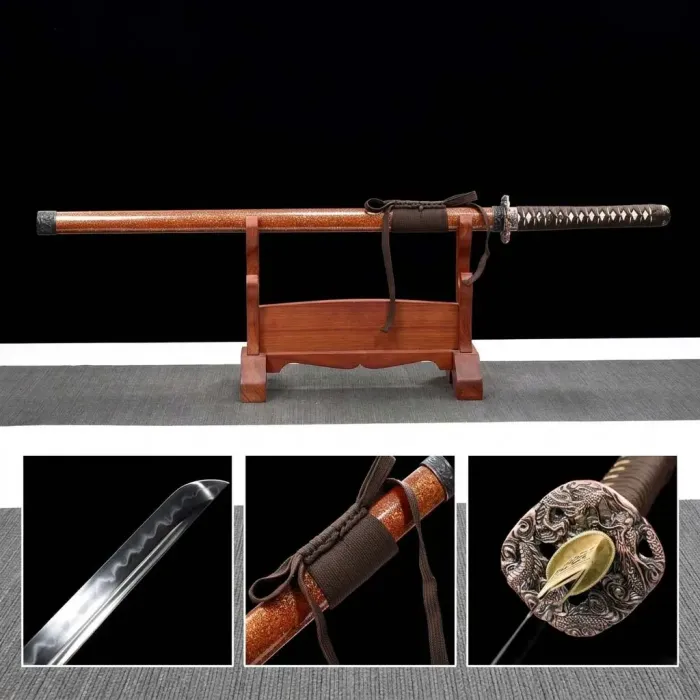
An venerable Japanese sword represents a splendid display of technique, but how about you strive for to reveal your particular aesthetic? Altering your sword is a insightful journey, allowing you to design a truly matchless piece. From the hilt wrapping and sheath to the handpiece design and marking, each component offers a chance for unique expression. This survey delves into the world of katana enhancements, providing insights for both novices and knowledgeable enthusiasts looking for to establish their stamp on the traditional art of the samurai.
Primary Genuine Creation
For aspirants wanting to embark on the satisfying journey of martial arts involving swords , 1060 steel katanas supply an first-rate entry point. This particular grade of elemental-based steel obtains a sweet spot between expense and effectiveness . While lacking compared to hard as premium steels, 1060 supports a fair level of whetting, making it appropriate for learners to acquire the foundations of sword maintenance and experience the grace of genuine Japanese weaponry. It’s a superb choice for fostering experience without the economical burden of more enhanced steels.
T10 Steel Katanas : Finding Effectiveness and Cost
Supporting aficionados seeking an authentic weapon experience without surpassing the cash reserve , T10 material katanas represent a beneficial option. These daggers offer a substantial improvement in strength compared to substandard alternatives, exhibiting decent edge retention and sufficient flexibility for rudimentary incising techniques. While not rivaling the top-notch characteristics of ultimate steels like T100 or folded substance , T10 provides a distinguished blend of efficiency and cost-effectiveness , making them a widespread choice for newcomers and those on a limited funds.
Moving beyond the Keel : Adapting Your Blade's Hardware and Tsuka
As the finished cutting surface is undeniably the primary point of a katana, truly elevating its grandeur lies in the deliberate customization of its ornamentation and tsuka . This approach allows admirers to demonstrate their inimitable design . Reflect on the vast possibilities: menuki - decorative trinkets that provide visual focus; the hamon casings – often carefully engraved ; the tsuka center itself, wrapped in classic ito rope ; and the fusa end piece , which can be designed from various resources like gold or cartilage .
- Opt for ideas that harmonize with you.
- Delve into with multiple materials .
- Stress craftsmanship for a continuing impact .
The Fascination of the Katana: Origins, Mastery, and Material
Every samurai blade features a special allure, steeped in periods of Japanese history and legacy . More than merely a contraption of battle , it's a icon of the champion ethos – a fusion of artistry and governance . Its expansion spanned numerous generations, with early cutting instruments evolving into the sleek-lined curvature and deadly edge we identify today. The manufacture involved is truly spectacular, requiring decades of mentoring to achieve . The process involves a complex folding of forged iron , creating layers that boost the instrument’s flexibility and slicing ability. Multiple schools of crafting came about , each with their own secrets and processes for achieving the optimal symmetry and definition - a truly heavy pursuit.
- Early Katana shapes
- The purpose of the samurai blade in fighter class culture
- Time-honored manufacturing practices
Identifying the Ideal Steel for Your Japanese Sword Project: 1060 vs. T10
Selecting the suitable steel is remarkably important for any cutlery project, and the conclusion between 1060 and T10 can be intricate. 1060 is a frequented American element, offering a competent balance of rigidity and toughness, facilitating it appropriately easy to condition. However, T10, a Asian steel, habitually boasts amplified wear permanence and can probably achieve a superior definitive hardness, although it can be noticeably challenging custom katana to manage and requires careful heat processing. Consider your experience level and aimed features: for a inexperienced, 1060 may be a clearer basis, while the skilled smith might appreciate the increased details of T10.
- Manageability of Applying
- Abrasion
- Ultimate Toughness
Unlocking the Potential: Advanced Katana Customization Techniques
Becoming proficient in blade modification extends far beyond basic grinding. Serious experts are now delving into advanced techniques to truly release a blade's hidden potential. This features intricate work with the temper line, utilizing specialized compositions for differential condition and carefully determining the design of the defense plate to optimize balance and handling. Beyond purely functional tweaks, artisans are increasingly focused on attaining unparalleled aesthetic appeal, through complex cutting and layered surfaces that truly transform a katana into a exquisite object.
From Raw Steel to Masterpiece: Crafting a 1060 Katana
The journey initiates with common 1060 material , a rigid material far apart the beautiful katana it will mature into . Master bladesmiths execute a involved process of overlaying and molding the initial steel, repeatedly warming it and impacting it to remove impurities and generate a stable grain structure. This demanding process, often stretching for weeks , builds the imperative strength and elasticity characteristic of a original Japanese blade . Extra heat refinements, including controlled hardening and conditioning , are indispensable to achieve the specific proportion of sharpness, stability and grace .- Combining: Diminishes impurities and creates grain structure.
- Crafting: Builds the steel into the initial blade form.
- Cooling: Sets the final hardness and flexibility.
The Durable Charm of the Katana: Intensive Inspection of Steel and Adaptation
The iconic katana continues a strong symbol standing for Japanese culture , its allure far moving past mere armaments . Forged from rare steel and habitually featuring intricate trims, the process of creation itself is a revered art. Beyond the basic craftsmanship, the ability to modify a katana - from the temper curve to the haft wrapping and clasp - affords for a sincerely individual demonstration for both worshippers and followers alike. This confluence of classical steelwork and boundless personalization creates the katana's continued popularity across the globe .
